Creative Music Composition - The Young Composer's Voice - Margaret Lucy Wilkins
This book has been used to teach composition for some time but the pricing on it is outlandish at the moment! My partner Audrey found her copy on a trip home to Singapore and she has been kind enough to lend it to me.
Margaret Lucy Wilkins is an English music educator and composer best known for her operas. She directed the Composition program at the University of Huddersfield in the United Kingdom from 1976 to 2003. Wilkins founded the Scottish Early Music Consort and a new music ensemble called Polyphonia. She has been a member of the executive board of the British Academy of Composers and Songwriters, the council of the Society for the Promotion of New Music, the board of directors of the International Alliance of Women in Music, and the honor committee of the Fondazione Donne in Musica.
In the first 4 chapters, just over a third of the length, this book reviews music from the 20th century, and some earlier, in order to present a breadth of compositional devices. Wilkins' intent with this book is to promote a more exploratory pedagogy for composition than what we regularly see in music theory classes today. Rather than imitate the style of well known or successful composers, she encourages the reader to make note of techniques and devices that interest them, and to use those as tools to find their own compositional voice.
I won't list every composer and technique here, but I will list those that were new to me and others that simply drew my attention
A few composers and projects that drew my interest:
Michael Tippett
Elliott Carter
Paul Hindemith and his collection of Sonatas for each orchestral instrument with piano
Karlheinz Stockhausen and his work Mantra
Birtwistle and his opera The Mask of Orpheus
CHANT - an early vocal syntesis program from IRCAM
Saariaho and her work Verblendungen
Wilkin's and her own first symphony
Messiaen and his Quartet for the End of Time
John Adams
Louis Andriessen
Steve Reich
Arvo Paert
Phillip Glass
Edward Gregson
More Detailed Genres from the 20th century and example composers:
12-tone: Schoenberg, Webern
Avant Garde: Boulez, Stockhausen
Post Serial: Birtwistle
Post Modern: Gorecki, Ulstvol'Skaya
Experimental: Cage, Oliveros
New Tonality: Weir
Polystylicity: Schnittke
Spectralism: Murail, Teodorescu
Gesture: Gubaidulina [7 words]
Spatialization: Musgrave
Microtonality: Xenakis, Scelsi
New Complexity: Ferneyhough
Sonic Composition: Saunders
More ideas and associated composers
Attempt to play Debussy's Syrinx, originally written at the bottom of the flute's range, on trumpet.
Per Norgard
Messiaen's Modes of Limited Transposition - these are scales or chords which can be transposed fewer than 12 times before creating identical material.
Invented Scales, wherein a composer decides the notes of a scale with little regard to tonal rules or similar ideas.
Scales and patterns that must span more than one octave
Boulez, Lutyens
Paul Hindemith's 1945 book on Chord Construction
Ralph Vaughan Williams' Sinfonia Antarctica, based on his score from the film Scott of the Antarctic
James MacMillan's Confession of Isobel Gowdie
Harmonic Field Technique, where most or all notes of a scale are played for an extended period
Isorhythm or Talea, where a rhythm is repeated for most or all of a piece of music.
Peter Maxwell Davies
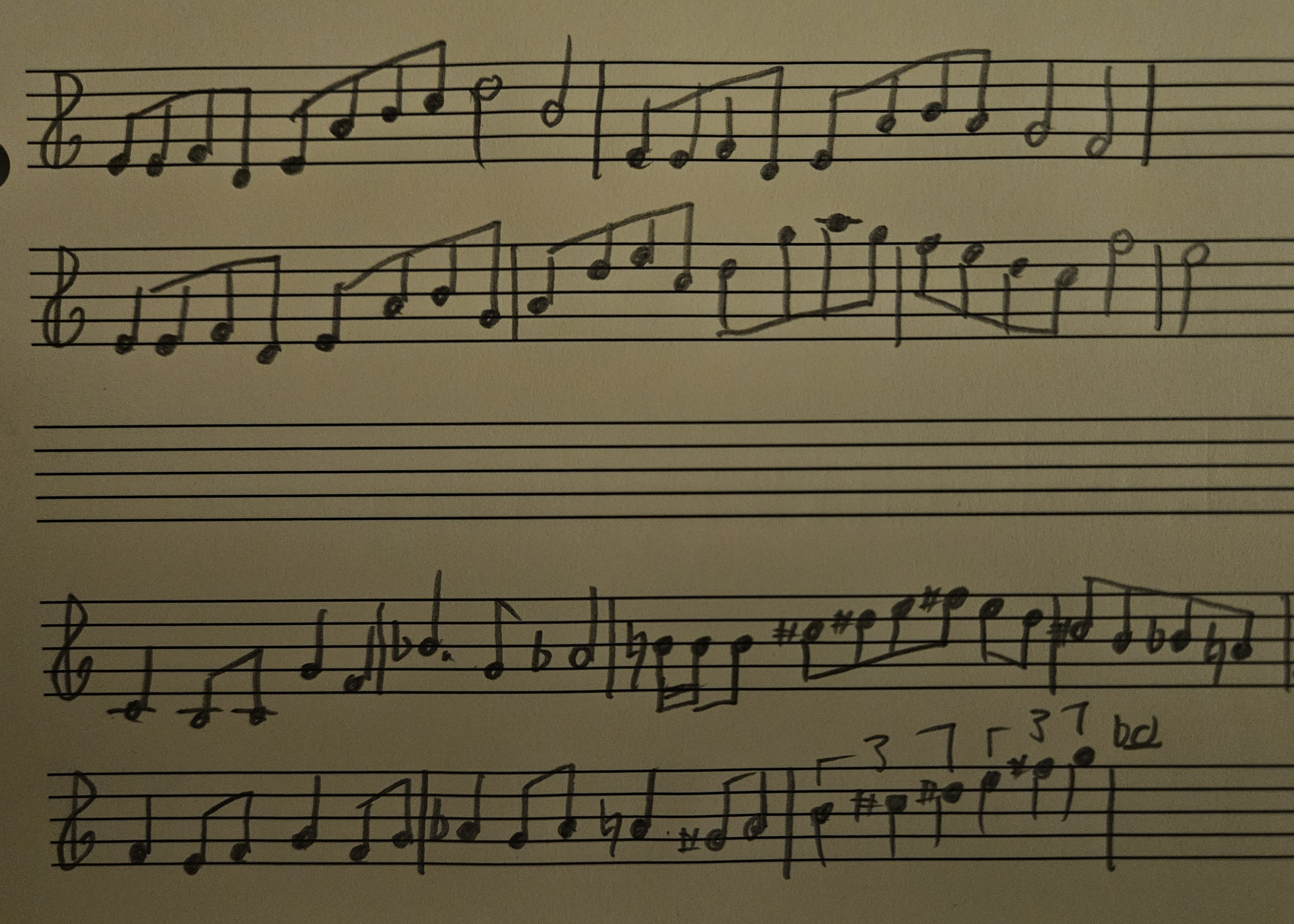
Exercise from Chapter 5
This is the first of 10 exercises in this chapter. The instructions here are to write three melodies for an instrument you play; one in a tonal scale, one in a modal scale, and one in a scale make up. On the third melody I think I roughly combined the C and B major scales, but I certainly didn't set out to make an exact version of that combination. While I will complete all of the exercises here, I will only include the first exercise from a section for this book, so to preserve the value of the book and that of my own writing.